

Whatever was Available
Muscles, myths, & the making of modern fitness

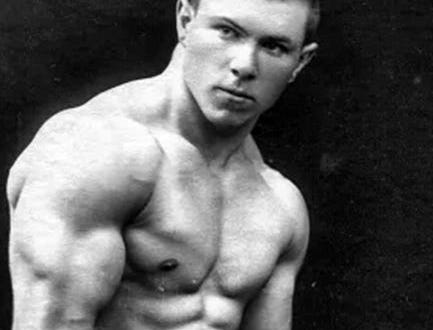
Conor Heffernan is a historian of strength, sport, and physical culture. A Lecturer at Ulster University, Conor writes about muscles, myths, and the making of modern fitness including the terrific Physical Culture Study here on Substack. Conor, thanks for taking the time to answer a few questions for Vale Tudo readers.
What is physical culture?
The desire to look better naked.
More ‘properly’, I use the Stark Centre’s definition (the Stark Centre is the primary archive for strength). They go with:
We define Physical Culture as the various activities people have employed over the centuries to strengthen their bodies, enhance their physiques, increase their endurance, improve their health, fight against aging, and become better athletes.
Elites keep breaking records while the general population remains sedentary; is this paradox new?
This paradox goes back much further than people assume.
In 1901, Eugen Sandow, the most famous strongman alive, staged what is believed to be the world’s first major bodybuilding competition at the Royal Albert Hall. The audience sat in evening dress and applauded men flexing on a stage, then went home and did nothing.
Sandow knew this. He wrote about it obsessively in his magazine Physical Culture and spent the following years trying to build a chain of gyms to convert spectators into participants. He ran his institute on St. James Street from 1897, eventually converting it into a Curative Institute in 1907. His latter years were overshadowed by financial difficulties. You need an audience of non-participants to fund the performers, and that structural problem has never gone away.
My grandfather called his cigarettes “coffin nails,” slang dating from the mid-1880s, long before scientists published studies of their health risks. Do people really need more information about health and fitness or more inspiration to act on what they already know or could easily find out?
Your grandfather’s coffin nails point is one I use in lectures.
Working-class Britons in 1880 lived in cities where the air was visibly toxic, food was routinely adulterated with chalk and sawdust, and working hours left no time for anything resembling exercise.
They did not need more information. They needed an eight-hour working day, which they did not get until 1919 in Britain, and affordable uncontaminated food, which required the 1875 Food and Drugs Act to even begin addressing.
The information problem in health and fitness has always been overstated. The infrastructure problem has always been understated. In 1900, a Manchester factory worker could not afford a gym membership, could not take time off for a walk, and was eating bread cut with plaster of Paris. Telling him to make better choices would have been insulting.
We are making a version of the same mistake today when we attribute population health failures primarily to individual decision-making.
What fitness practice from the past deserves revival? And what deserves to stay buried?
What deserves revival is lifting heavy, awkward, uncooperative objects.
Before barbells were standardised in the 1880s, strongmen lifted whatever was available: anvils, beer barrels, mill stones, loaded carts, and enormous field stones. Strength was expressed through objects rather than calibrated equipment.
Thomas Inch, one of the greatest British strongmen of the Edwardian era, had a 172-pound dumbbell with a handle so thick, two and three eighths of an inch in diameter, that almost nobody could lift it off the floor with one hand. Arthur Saxon attempted it and failed. So did Lionel Strongfort and Ivan Poddubny.
That object-specific challenge, where the implement itself is the problem and not just the weight, develops grip, proprioception, and concentration that no standard gym movement replicates. I lift traditional Irish stones for exactly this reason. They have no obvious grip point. You negotiate with the stone every single time.
For something that deserves to stay buried: the Vibro machine, sold across Britain and America from the 1890s through to the 1920s, which promised to deliver all the benefits of vigorous exercise while you stood still.
The device shook you at high frequency. Some versions used steam power, and the marketing claimed it would stimulate lymphatic drainage, burn fat, and develop muscular strength without any effort on your part.
Battle Creek Sanitarium, run by John Harvey Kellogg, the cereal man, had an entire ward of these machines that wealthy patients used while reading newspapers. They accomplished nothing. Several people were injured when the machines malfunctioned.
They were also wildly popular and made fortunes for their inventors. I am slightly nervous we are reinventing this right now with certain passive recovery devices, but the Victorian originals were genuinely dangerous.
What did physical culturists eat?
The most instructive dietary figure in physical culture history is George Hackenschmidt, the Estonian-born wrestler who was probably the strongest man alive between 1900 and 1910.
He held the world heavyweight wrestling championship, bent pressed 269 pounds, and full-squatted serious weight for reps. His dietary advice, published in The Way to Live in 1908, was simple:
Two meals a day, no eating between meals, and prioritise raw milk, eggs, and simply prepared meat.
There were no supplements, no meal timing protocols, and no macronutrient calculations. Hackenschmidt lived to ninety-three and was still doing handstands in his eighties.
The contrast with his contemporary Eugen Sandow is instructive. Sandow published elaborate dietary prescriptions in his magazine and sold branded health foods. Sandow’s Health and Strength Cocoa was a real product, available by mail order, and it was essentially drinking chocolate with some malt extract.
The marketing was sophisticated. The product was not particularly useful.
For a recipe with a direct physical culture lineage, Arthur Saxon and his brothers, according to a detailed account of their daily routine that circulated in the strength press, ate roughly two dozen eggs and several pounds of bacon for breakfast. Dinner consisted of roughly ten pounds of meat with vegetables. After their evening performance they ate cold meat, smoked fish, butter, cheese and drank beer.
This is not a diet I am recommending. But the underlying principle, large quantities of simply prepared whole food eaten at fixed times, without snacking and without products, is completely sound and costs a fraction of any modern nutrition protocol.
Are supplements new?
Supplementation is as old as physical culture itself.
Roman gladiators at Ephesus, according to isotope analysis of their bones published in PLOS ONE in 2014, ate a diet high in barley and plant ash. The ash was deliberate. Elevated strontium-to-calcium ratios in gladiator bones compared to the general population led researchers to conclude that the ash drink described in ancient texts, including Pliny the Elder’s Naturalis Historia, really did exist.
Plant ashes were consumed to fortify the body after physical exertion and promote bone healing. The study leader Fabian Kanz from the Medical University of Vienna drew an explicit parallel with modern athletes taking calcium and magnesium supplements after training. The intent to supplement strategically is therefore present as early as the second century AD.
The golden age of fitness snake oil is the American 1890s and it is extraordinary. Sears Roebuck’s 1897 catalogue sold Compound Oxygen, essentially bottled air, as a training aid.
Allan’s Anti-Fat tablets, marketed specifically to women wanting to reduce, were primarily thyroid extract harvested from livestock. They did cause weight loss, but only in the same way that a low-grade thyroid condition causes weight loss: by making you ill.
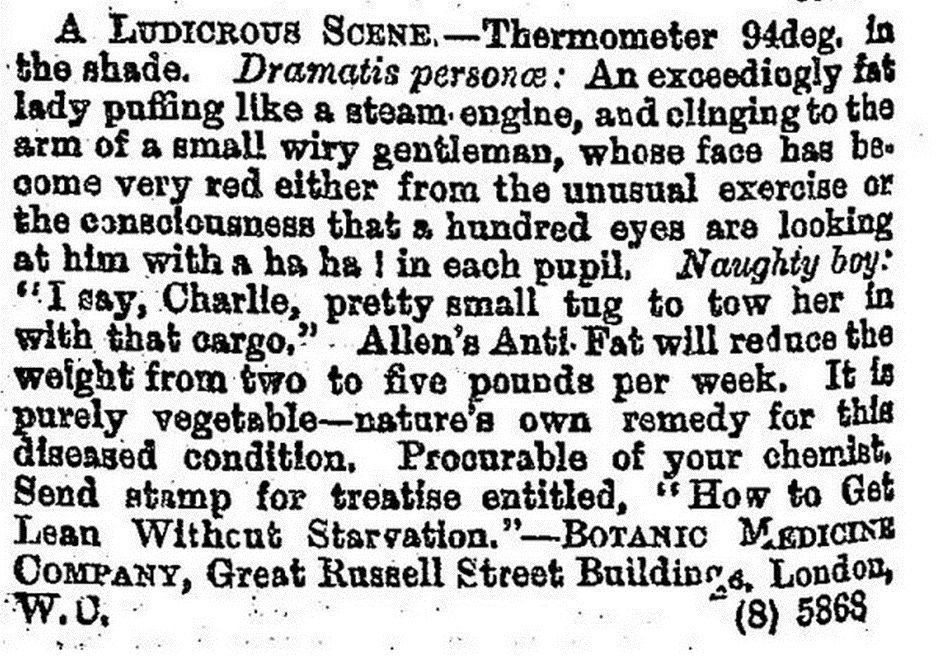
Strychnine in tiny doses does stimulate the central nervous system, which is why it appeared in various training tonics throughout the late Victorian period. It also, at slightly larger doses, kills you.
I take creatine because the evidence base is thirty years old and thoroughly replicated. That is basically it.
What did physical culturists measure?
The history of fitness measurement is largely a history of inventing numbers that tell people what they want to hear and calling it science.
Dudley Sargent ran the Harvard physical training programme from 1879 and spent the following decade and more measuring thousands of male students: every limb circumference, every angle, chest expansion, lung capacity, and grip strength.
In 1892 he compiled the statistical mean from over ten thousand college students and commissioned two sculptors, Henry Hudson Kitson and Theo Alice Ruggles, to render the average in physical form.
The resulting statues were exhibited at the Chicago World’s Fair in 1893 and presented as a scientific health standard. In reality they were an aesthetic ideal in scientific clothing, and they became the template for nearly every fitness measurement system that followed.
The most telling historical measurement trend is the decline of functional tests. Sargent himself used a vertical jump test, the Sargent Jump, that remains valid today and measures something real.
By the mid-twentieth century American fitness culture had largely abandoned functional measurement in favour of aesthetic measurement: waist circumference, body weight, photographs.
We are only now, with the rise of performance metrics in CrossFit, powerlifting and obstacle racing, returning to the question Hackenschmidt would have considered obvious: can you do more than you could before?
I do not weigh myself. I measure progress by whether the stones get easier and whether the barbell numbers go up.
How do you bounce back? Oddities worth reviving?
The Victorian answer to recovery was the Turkish bath, and they were genuinely onto something.
Over 700 Victorian Turkish bath establishments have been documented across Britain and Ireland, a remarkable density of infrastructure for heat and cold contrast recovery. They were accessible, often sixpence for a basic session, communal, and used exactly the physiological principles that modern sports science has confirmed do measurable things for recovery and cardiovascular health.
The Hammam on Jermyn Street in London, which opened in 1862, specifically marketed itself to athletes and sportsmen. Professional boxers, wrestlers, and footballers used it as standard post-competition recovery infrastructure.
Then indoor plumbing became universal, private shower rooms became the norm, and the communal bath was gradually reframed as a sanitation relic rather than a recovery tool.
Finland did not undergo the same privatisation of hygiene. We are rediscovering this now, slowly.
The most interesting historical recovery method that has essentially vanished is what the Victorians called constitutional exercise: a long, moderate pace walk taken specifically as active recovery and not as training.
Edward Barton-Wright, who introduced Bartitsu to London in 1898, was an enthusiastic advocate of walking as recovery practice. Conan Doyle famously misspelled the martial art as baritsu when Sherlock Holmes used it against Moriarty.
The idea was simple: not a jog, but a walk at a pace slow enough to hold a conversation. The evidence that this works, for recovery, cognitive function, and mood regulation, is overwhelming and has been accumulating for well over a century.
It requires no equipment, no membership, and no products.
Who is your hero among strength athletes?
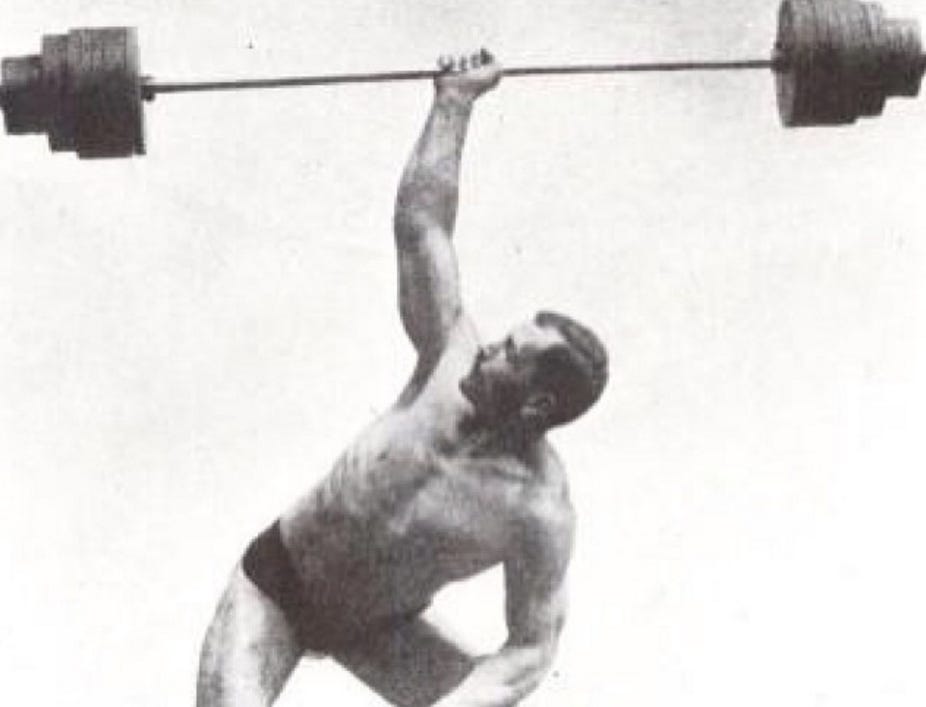
Saxon was a German strongman from Leipzig who performed throughout Britain and Europe between 1898 and 1914, and he bent pressed 370 pounds in official competition in 1905, taking that weight from the floor to overhead with one arm, bending sideways and rotating in the specific movement pattern the lift requires, 370lbs! He weighed about 200 pounds when he did it. No one has officially beaten that number in the century since, despite dramatically improved nutrition, training methodology, and pharmacology. What I find as compelling as the numbers is the book he published in 1905: The Development of Physical Power.
It is one of the most honest training books ever written. Saxon says, in essence:
I lift very heavy things very often. I have been doing this since I was a boy in Leipzig. I eat a great deal. His daily diet, documented in the strength press of the era, included roughly two dozen eggs at breakfast alone. I sleep as much as I can. I do not have a system. I have a practice.
The book has no progression schemes, no periodisation tables, no peak weeks. It describes what Saxon actually did, which was train twice daily, every day, with his brothers, lifting implements that most modern strength athletes could not approach.
Do you have a scholar/athlete tribe or are these groups separate in your life?
Almost entirely separate, and the overlap is smaller than I expected.
The stone lifting community, the people who gather at Cloch Nirt events in Kerry and Galway and Donegal, who drive two hours to lift a specific stone and then drive home, are warm, technically serious, and almost completely uninterested in the academic literature. When I mentioned that I had published a paper on Irish stone lifting in Irish Economic and Social History, the response from one of the best stone lifters in Connacht was a sincere and unembarrassed ‘fair play to ye’, followed by a detailed conversation about a specific stone’s grip surface. Which is exactly as it should be.
My academic colleagues are curious about the stone lifting in the way that people are curious about an unusual hobby. A colleague in the history department at Ulster asked me once, very politely, whether it was ‘a bit like CrossFit.’ It is not a bit like CrossFit. What has surprised me is the readership at Physical Culture Study, a website I have been running since 2014. I assumed I was writing for historians with a specialist interest. The people who have read it most consistently and most carefully are coaches, competitive lifters, and strength enthusiasts who want to understand where their sport came from: why the barbell looks the way it does, why powerlifting and Olympic lifting split in the mid-twentieth century, where the rep-set structure comes from. That audience asks genuinely good historical questions. The most interesting correspondence I have received about my research has come from a competitive powerlifter in Oslo, a classicist and club swinger from America, and a kettlebell coach in New Zealand. None of them has a history degree.
How is Irish stone lifting culture?
Irish stone lifting is more alive than almost any traditional physical culture I have encountered. We have documented forty-two verified stones across the island through a registry I have been building with the community: stones with confirmed lifting histories, some traceable through oral tradition to the seventeenth century, some with unbroken community competition practices. People do travel specifically for the stones. I have met lifters from Norway, the United States, and Australia who have come to Ireland with a list of specific stones as their itinerary. The Scandinavians in particular recognise something familiar. There are Norse husafell-type traditions of lifting and carrying heavy stones that are clearly cognate with the Irish tradition, and the more serious practitioners are aware of the shared history. We are pursuing Intangible Cultural Heritage status for the tradition, a UNESCO-adjacent designation that recognises living cultural practices worth preserving. It has been more complicated than I anticipated, involving ministerial correspondence and some archaeological sensitivity about specific sites that I will not detail here, but the direction of travel is positive.
My favourite stone I am deliberately vague about in public, to protect the landowner’s goodwill with access. What I will say is that it weighs approximately 220 pounds, is roughly spherical with no obvious grip point, and sits on working farmland. Lifting it for the first time on a grey October morning, with the farmer watching from a gate, felt like touching something that had been waiting a long time.
What are you currently working on?
Several projects simultaneously, which is either industriousness or poor impulse control. The most immediate is a book called Ireland’s Impossible Olympics, about the Tailteann Games: an ancient Irish athletic festival revived in 1924 as a deliberate act of nation-building by the new Free State government. The 1924 Games brought 5,000 athletes to Dublin from across the Irish diaspora, included events ranging from athletics to Gaelic football to motorboat racing on the Liffey, and were attended by figures including Douglas Fairbanks and W.B. Yeats. They ran three more times, in 1928, 1932, and a truncated version in 1936, before collapsing under a combination of the Depression, government indifference, and the impossibility of sustaining diaspora participation once the first nationalist excitement faded. It is the best sporting story almost nobody outside Ireland has heard. My agent is taking it to publishers shortly.
My book When Fitness Went Global came out last November from Bloomsbury, a global history of how fitness became a worldwide industry and obsession from ancient Greece to the contemporary wellness complex. That is probably the most accessible entry point.
Everything is at Physical Culture Study on Substack or my website Physical Culture Study!
One thing from an earlier era that readers could bring back for a month?
Walk everywhere you possibly can, for thirty to sixty minutes a day, without listening to anything. The unlistened-to part matters as much as the walking itself, and I say this as someone who listens to podcasts constantly and has to actively fight the habit. It is free. It requires nothing. It has been working for 200,000 years. The reason it does not get marketed more aggressively is that nobody makes any money from it.
Thanks, Conor, for taking the time chat about fitness. This was fun.
Saved for continued reference and enjoyment. This was so good guys
Selling air... dammit. Why didn't I think of that!?!